

There was a stretch when the live question in CPG marketing was whether Facebook advertising sold physical products in physical stores. Plenty of people had opinions. Almost nobody had a measurement design. We took on the question for Duncan Hines and Birds Eye with a structure built to produce an answer rather than a deck: quality content, amplified by managed Facebook media, with the impact on incremental sales measured by a third party, Datalogix, later acquired by Oracle.
The third-party part was the point, and it was a genuine risk worth naming, because agreeing to outside measurement before the campaign runs means agreeing to a verdict you cannot edit. If the answer had come back flat, there would have been no attribution model to switch to, no window to lengthen, no flattering recut of the data. That is exactly why the answer was worth having. Bricks and clicks connect through purchase data, not platform dashboards, and having an outside firm match exposure to actual sales meant the result would be credible whether or not it flattered us. I have spent years since arguing that attribution systems that grade their own homework should not be trusted with the final word. This campaign is where that conviction comes from. We volunteered for outside grading before it was fashionable, and the vulnerability is what made the numbers worth anything.
The targeting was the early part
We developed all the sponsored content and ran the media strategy end to end. The audience work is what I would still show a client today. Custom segments built from brand and competitor SKU purchase data, so the ads reached people who demonstrably bought cake mix and frozen vegetables, including the other brand's; the competitor-buyer segment is the one I would underline, because a household already buying the category from someone else is the highest-value conversion in CPG and the one interest targeting can never find. Custom Audiences from email files. Pixel Audiences from site visitors. Lookalikes modeled from all of it, with conventional demographic and interest targeting as the floor rather than the strategy. Buying against actual purchase behavior is ordinary now. Back then, for grocery brands, it was the whole argument, and it is why the campaign could survive third-party grading: the targeting and the measurement were built from the same substance, real purchases, end to end.
Datalogix matched exposed households to actual store sales, and the answer came back unambiguous. Birds Eye generated $6.3 million in incremental sales on a $217,000 investment over two months, a 29x return. Duncan Hines generated $3.98 million on $330,000 over three months, a 12x return. Those are register numbers, matched to households, scored by a referee with no stake in the outcome, and the word incremental is carrying the weight in both sentences: not sales that occurred near the campaign, sales that occurred because of it, above what matched unexposed households bought. Platform-reported conversions rarely survive a CFO’s scrutiny. These did, and the difference in the room when you present a refereed number versus a self-reported one is the difference between defending your budget and setting it.
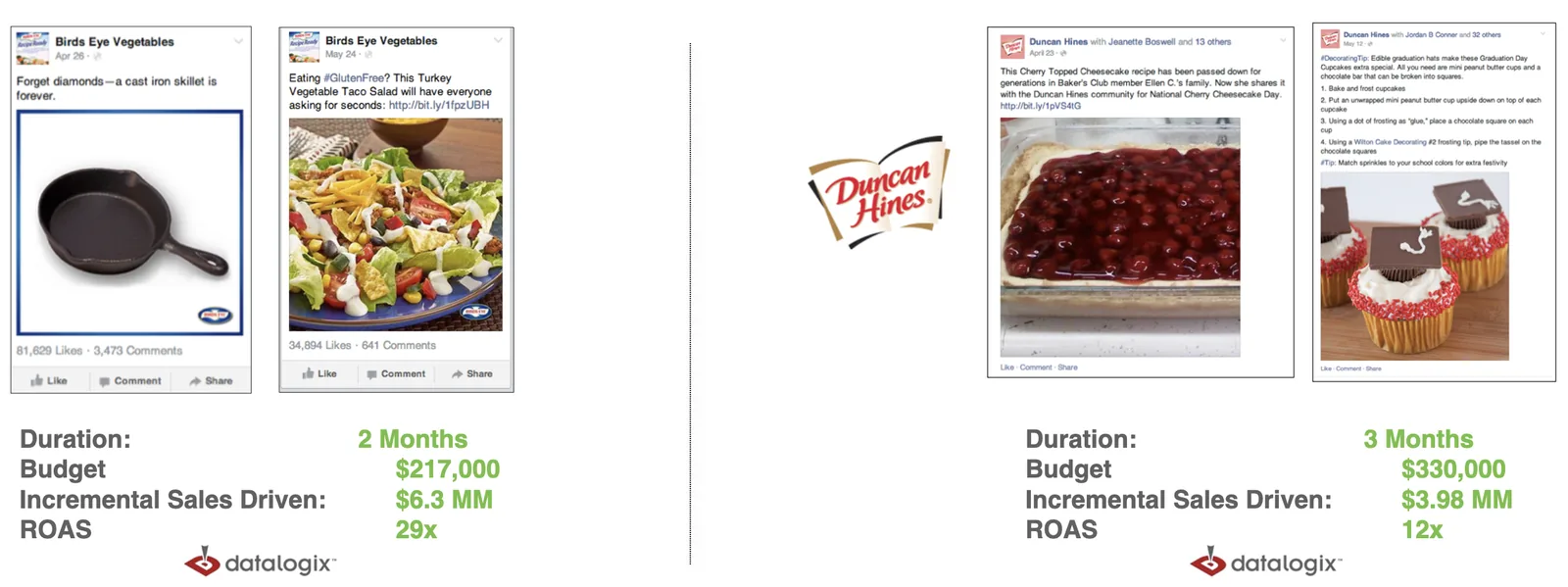
One more detail worth keeping: the two brands returned 29x and 12x on the same platform, the same methodology, and the same agency in the same year. That spread is the quiet second finding. Channels do not have returns; campaigns in categories with specific margins and specific purchase cycles have returns, and anyone quoting you "Facebook returns X for CPG" is averaging away the only information that matters. What the engagement proved to me permanently: the interesting question is never whether a channel works, it is whether you have built a way to know. Decide how you will measure before you spend, get the referee from outside the building, and target from what people buy rather than what they claim to like.