

Simon is the largest owner of premier shopping, dining, and mixed-use destinations in the world, with properties across North America, Europe, and Asia that generate billions in annual sales. Our brief had two verbs in it, and the order mattered: drive online traffic to Simon SAID, their editorial site, and drive foot traffic to Simon Centers.
A mall owner running an editorial property sounds like a vanity project until you think about what Simon actually sells. Simon does not sell sweaters. It sells the visit. Every retailer in every center depends on someone deciding that going to the mall is a thing worth doing this weekend, and that decision gets made on a phone, days before any store's own marketing has a chance to matter. This was also the era when the retail apocalypse narrative was at full volume, and the standard industry response was defensive: loyalty programs, coupon blasts, discounting the visit that used to sell itself. Simon's move was the opposite and, I would argue, the correct read of the actual problem. Foot traffic was not declining because malls got worse. It was declining because the decision to go was being made in a feed the mall had no presence in. Simon SAID existed to own that upstream moment: style content, dining, seasonal programming, the reasons a trip happens.
Media built for a two-step conversion
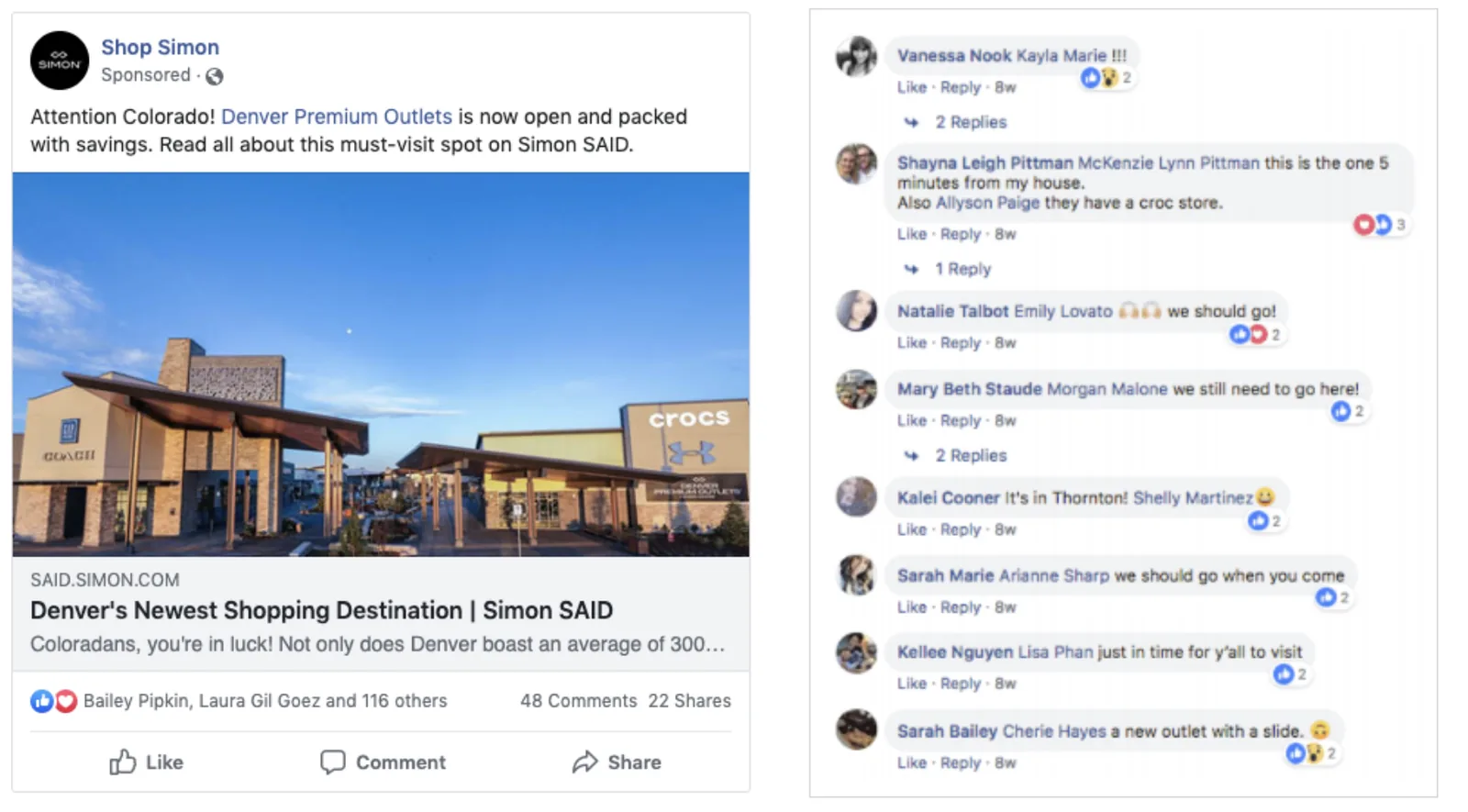
The advertising strategy treated the editorial site as the middle of the funnel rather than the end of it. Paid social put Simon SAID content in front of shoppers in each center's trade area, geographically tight enough that the reader was always someone who could act on it within a short drive. Trade-area tightness was the entire targeting philosophy: a great story about Denver Premium Outlets shown to a reader in Atlanta is content marketing, and the same story shown to a reader twenty minutes from the property is a visit being scheduled. Same asset, same platform, and the geography is the difference between the two. The content did the persuasion. The centers collected the visit.
Measuring that second step meant leaning on location signals and center-level performance rather than the click, which is a version of an argument I keep coming back to about counting the right outcome instead of the countable one. The click was the easy number and the wrong one; a campaign graded on traffic to the editorial site would have optimized toward cheap national readers who were never going to stand in a Simon property. Grading it on center-level signals kept the media honest about the verb that actually paid the bills, and the discipline of refusing the convenient metric is, in hindsight, the most senior decision in the whole engagement.
The lesson that travels
What this engagement taught me travels well beyond malls. When your real conversion happens offline and days later, content is not a branding indulgence. It is the targeting mechanism. A reader who chose to spend three minutes with a what-to-wear piece tied to a specific property has qualified herself more precisely than any audience segment I can buy; the three minutes are a declaration of intent no interest category can match. Physical retail marketing keeps trying to skip that step and jump straight to the coupon, and the coupon reaches everyone equally, which is to say it qualifies no one. Any business with an offline conversion, dealerships, medical groups, universities, restaurants, is sitting on the same mechanism: publish the thing your customer reads while deciding, put it in front of the geography that can act, and measure the arrival, not the click. Simon understood the visit has to be sold first. Most physical businesses still have not, which means the play is still open.